How Prediction Markets Could Be Used In Securities Litigation

Share
In an article for Law360, Faten Sabry, William Hrycay, and Brad Shulman examine how prediction market prices might serve as evidence in securities class actions, M&A disputes, and bankruptcy proceedings.
This article was originally published by Law360 here. The views expressed in this article are the sole responsibility of the authors and cannot be attributed to Compass Lexecon or any other parties.
Prediction markets, often called information markets or event futures, enable participants to trade contracts with payoffs that are contingent on the outcomes of uncertain future events.
Kalshi and Polymarket emerged as the two largest platforms by volume of trading. The combined monthly global trading volume on these platforms has risen from less than $5 billion in September 2025 to about $24 billion in April 2026, according to a Pew Research Center analysis.[1]
Recent academic studies demonstrate that prediction markets can be efficient aggregators of information. Based on these findings, we identify possible applications of prediction market prices in litigation. We also demonstrate how prices from prediction markets could be used in securities class actions, litigation involving mergers and acquisitions, and bankruptcy proceedings, and discuss the caveats of relying on prediction market prices.
Demonstrating the Use of Prediction Market Prices in Securities Litigation
Consider the following hypothetical dispute. Omni Corp. faces allegations that throughout the second quarter of 2026, executives knew that demand for its SoggyStraws — an eco-friendly straw made entirely of protein bars — would collapse, reducing revenue and earnings. This product was marketed as the only straw that doubles as a snack.
On April 1, executives assured the market that the demand for the product was going to break records after it was launched in the summer.
The management guidance for the earnings per share, or EPS, estimate for Omni was $2. The launch of SoggyStraws was expected to contribute to current earnings and future growth.
But on Aug. 15, Omni reported a disappointing EPS of $1.60, which was attributed to the disappointing performance of SoggyStraws, and the company also announced that several other new products currently under development would be delayed or canceled. Following the announcements, Omni's stock price dropped significantly.
Litigation ensued alleging misrepresentation and artificial price inflation, with the plaintiff claiming that Omni's stock was inflated for the entire second quarter because the company executives knew that the highly touted project suffered from a fatal flaw — it trapped beverages inside and made it impossible for people to consume their drinks.
Would prediction markets be able to help evaluate the economic analysis of the allegations of price inflation? The short answer, like that of most economic questions, is "it depends." This article discusses some of the uses of prediction market prices in other types of disputes like M&A and bankruptcy litigation.
Reliability of Prediction Markets
Using prediction markets as financial platforms, users can trade event contracts with payouts that are based on the outcomes of real-world events, such as elections, sporting events or macroeconomic releases. For example, an event such as "Will Company X file for bankruptcy by Dec. 31?" may have a prediction market contract with a "yes" or "no" outcome.
Traditional betting relies on a centralized bookmaker that sets fixed odds and acts as the counterparty to wagers. Unlike these traditional betting markets, Polymarket, Kalshi and other prediction markets are peer-to-peer, and prices of the event contracts reflect the crowd-sourced probability of an event.
For example, a "yes" contract valued at 60 cents means that the event has a 60% chance of occurring. A user then pays 60 cents to buy a contract and receives $1 if the event occurs and $0 otherwise.
Recent academic papers reached different conclusions about the value of the information provided by prediction markets. For example, Joshua Mitts and Moran Offir concluded in a paper published in April that event contract platforms are exploited by insider trading, based on the authors' own classifications of suspicious trades that generated an estimated $143 million in profits.[2]
On the other hand, Roberto Gómez-Cram, Yunhan Guo, Theis Ingerslev Jensen and Howard Kung wrote in a June paper that prediction markets produce "remarkably accurate forecasts" and concluded that "accuracy comes from a minority of persistently skilled traders" who are not necessarily insiders and exhibit depth and breadth of expertise.[3] In addition, Wan Chu Cheong and Ane Tamayo found in June that the informativeness of earnings prediction markets seems to reflect concentrated informed trading, consistent with the wisdom of the few rather than the wisdom of the crowd.[4]
The presence of certain investors — either inside traders or skilled traders — who provide reliable assessments about earnings or other corporate events may make stock prices more efficient, as stock traders could learn from prediction markets. This means that certain event contracts could inform the markets about the value of publicly traded companies and, in turn, about market efficiency.
Our article focuses on a narrow contract related to EPS, a key financial indicator for publicly traded companies. On Sept. 15, 2025, Polymarket introduced a new category of event contracts dedicated to forecasting the earnings of publicly traded companies. The "yes" contract pays $1 if the realized EPS are above the amount specified in the contract. You can think of the contract price as the market-implied probability of Omni beating the management estimate at the transaction date of the event contract.
In securities disputes, economists rely on historical analysts' forecasts that cover the public company in question, among other market evidence, to evaluate how these forecasts changed over time leading up to the actual announcement of earnings.
Unlike historical analysts' forecasts from the Institutional Brokers' Estimate System and other industry sources, Polymarket prices for the EPS event contracts provide a continuous measure of the market's evaluation of earnings estimates. These prices adjust or could adjust almost instantly as new information about Omni is revealed.
Assuming there are enough contracts betting on Omni's performance, the prediction market prices could provide a valuable assessment of the market consensus that adjusts faster than existing analysts' forecasts.
Prediction Market Prices Can Signal Likelihood A Company Will Meet Its Earnings Before the Actual Announcement
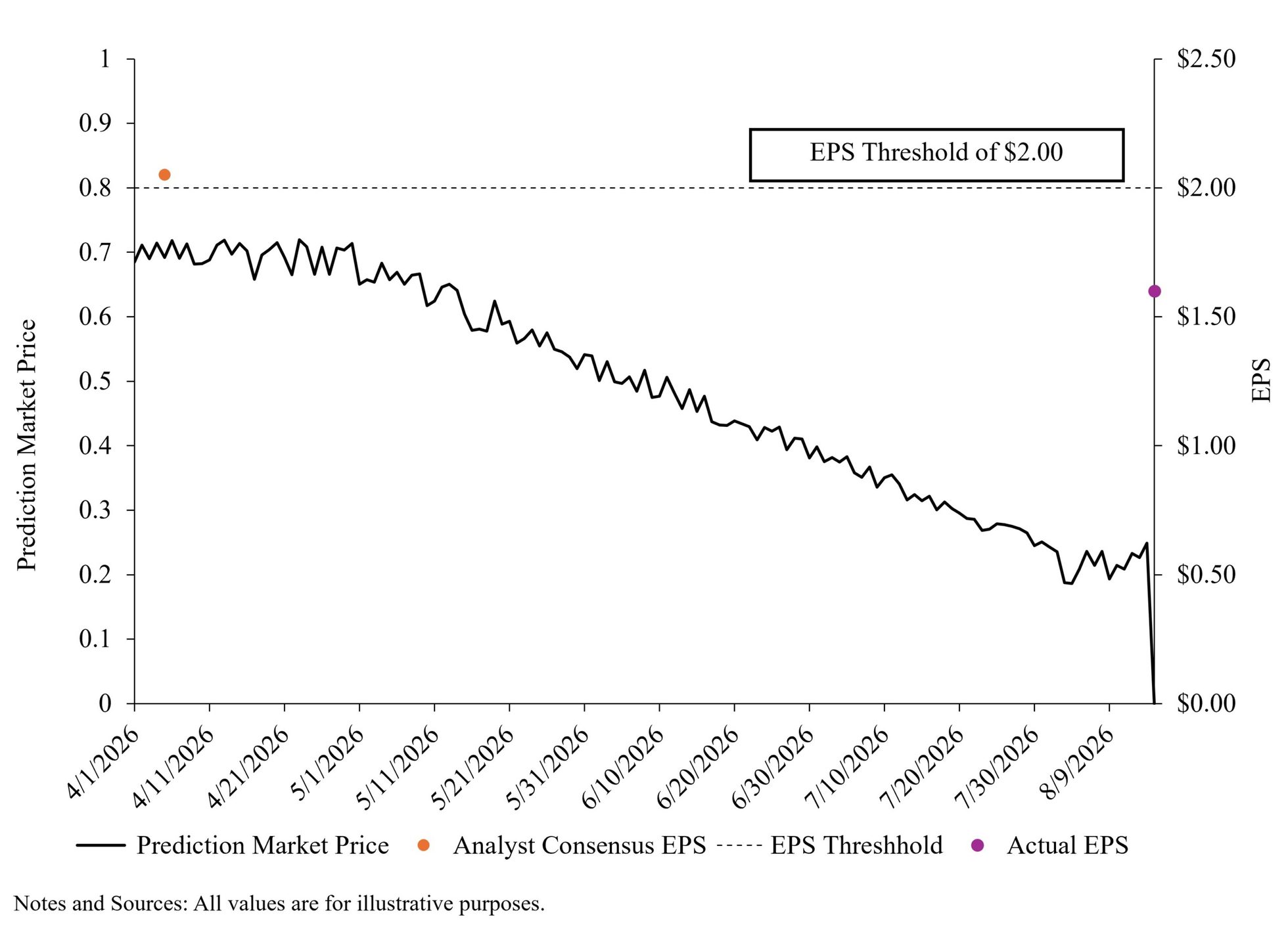
Chart 1 below presents the hypothetical prices of EPS event contracts from April 1 to Aug. 16 that bet on whether Omni's second-quarter EPS will exceed the management's guidance of $2 per share. The chart also presents the consensus of analyst forecasts as of April 5, which was slightly above management forecasts. The black line represents the price of a contract that would pay $1 in the event that actual earnings were $2 per share or greater.
For example, the price of the contract started at around 70 cents and decreased to around 20 cents by early August, before the announcement. The contract price decreased to $0 after Omni's earnings announcement reported an actual EPS of $1.60, which was lower than the amount of $2 stipulated in the prediction market contract.
The prices of the EPS event contract demonstrate that it was unlikely for Omni to meet its projected guidance long before the reporting of its second-quarter results. Even though the analysts' consensus forecast did not change in this hypothetical example, the prices of the EPS contract would have provided market-based evidence that the market factored in the increased likelihood that Omni would miss its earnings forecast prior to the announcement.
Chart 1: Hypothetical Omni Prediction Market Price and 2Q IBES Forecasts
April 1 to Aug. 15
Polymarket Transaction Prices for EPS Contracts for Publicly Traded Companies Since September 2025
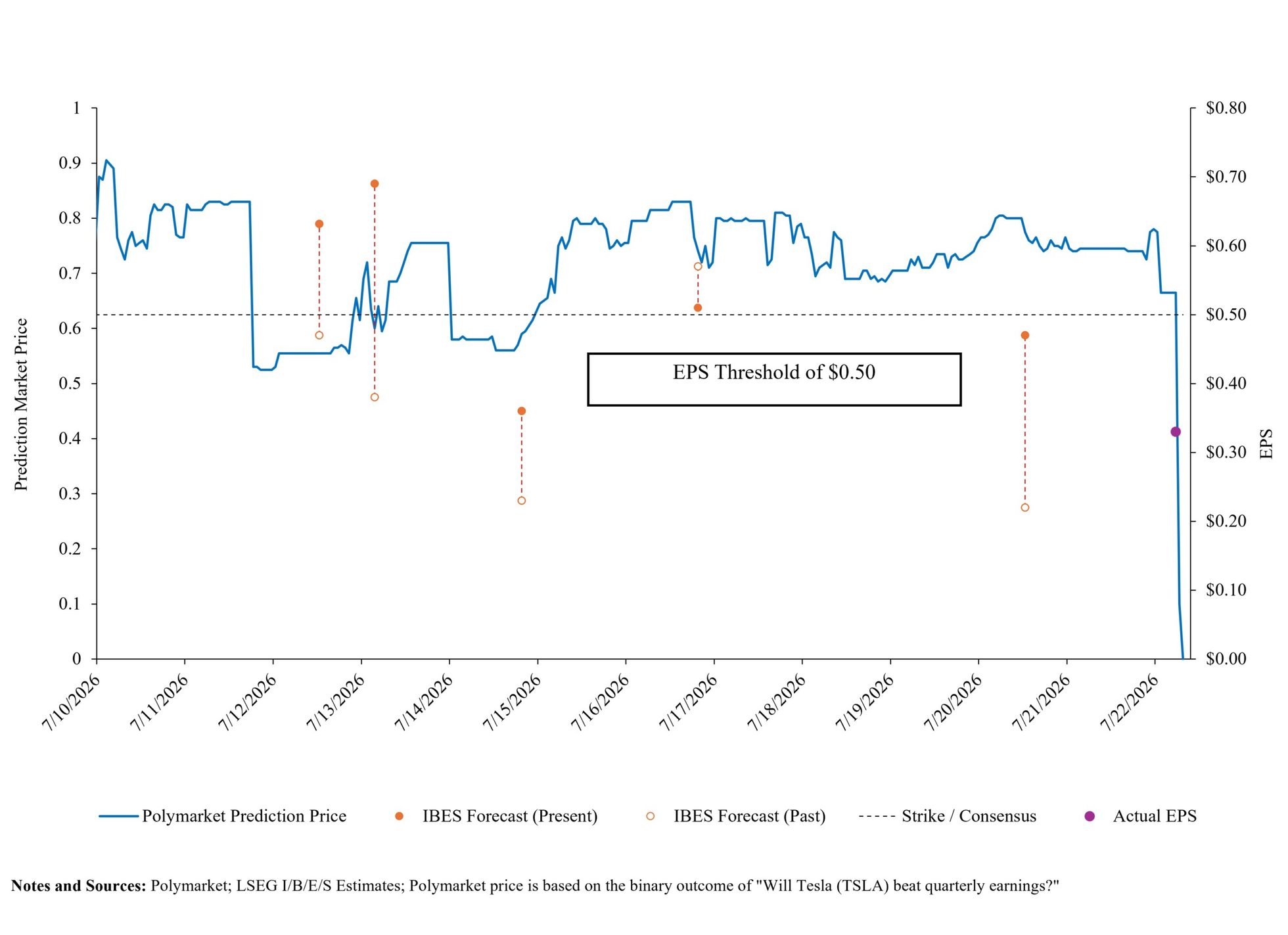
Given that Polymarket settles its trades on a public blockchain, one can observe all trades and link them to individual accounts.[5] For illustrative purposes only, Chart 2, below, presents actual trading data from Polymarket for the hourly prices of all the contracts related to the question "Will Tesla (TSLA) beat quarterly earnings?" for the second quarter of 2026. The contract specified that it would pay $1 in the event that Tesla's second-quarter EPS was 50 cents or greater, or $0 otherwise.[6]
The blue line presents the Polymarket prediction prices, which show there was about an 80% implied probability of Tesla beating its earnings as of July 11. Then, the implied probability dropped to as low as 55% and then remained in the 70% range until close to the actual announcement.
In addition, the chart plots the change in the earnings forecast by individual analysts who changed their forecasts during the same time period.[7] For example, as of July 21, the forecast for one analyst increased from 20 to 35 cents.
Finally, the chart shows what actually happened. On July 22, Tesla announced its actual EPS to be 33 cents per share, which was below the contract threshold of 50 cents per share, and the value of the Polymarket contract on that question was resolved as a miss.
Chart 2: Polymarket Market Price and IBES Forecasts
Tesla Q2 2026 Earnings July 10, 2026 to July 22, 2026
Prediction market prices reflect the subjective beliefs of the market participants over time leading up to the announcement of earnings. They can be used to track how the public's beliefs shifted over time.
For example, by examining the slope of the contract's probability curve, one can identify when the market's view of expected earnings changed. This could be a way to test if the reduced earnings expectation was already priced into the market assessment ahead of the official earnings disclosure.
The prediction market price data in the chart above provides a granular, high-frequency supplemental metric to evaluate whether a stock price drop was possibly driven by new information or if the market had already anticipated the earnings before the announcement.[8]
Additional Applications for Prediction Market Pricing in Litigation
The Omni hypothetical demonstrates how prediction markets can be used to inform the market's subjective beliefs about market events of publicly traded companies.
In addition, prices from prediction markets could also inform economic analysis in other types of financial disputes, such as mergers, acquisitions and bankruptcy.
Mergers and Acquisitions
There are numerous event contracts on prediction markets that could indicate the market's subjective assessment of the probability of a company getting acquired.
For example, there are event contracts such as "Will GameStop acquire eBay?" or "Will Paramount close the Warner Bros. acquisition by the end of the year?" Changes in the prices of these types of contracts could be construed as market-based evidence that the transaction would be completed.
For example, participants can buy contracts on Kalshi on the M&A activity of at least 13 companies. Prices of the contracts varied between 2% and 93%.[9]
Bankruptcy
Similarly, the prices of prediction market contracts regarding the likelihood of a company filing for bankruptcy could provide measures of the likelihood of bankruptcy by a certain date. For example, one can buy a "yes" or "no" contract on Polymarket as to whether JetBlue Airlines will announce that it will file for bankruptcy before Dec. 31, 2026.
This information could validate or supplement other market-based indicators of the likelihood that a company will default, such as credit default swap prices, bond prices or equity prices.
Limitations of the Prediction Market Prices
However, there are hurdles to address before using this novel data to assess allegations of price inflation against Omni.
First, economists must evaluate the reliability and liquidity of the event contracts in question. Unlike equity stock prices, which typically trade with deep liquidity, prediction markets can suffer from thin trading volume and possible susceptibility to localized manipulation.[10]
Second, whether the probability of an event declined over time according to prediction markets may not necessarily be sufficient on its own to conclude that the market believed the event would not happen. The economic analysis should also demonstrate the association between changes in the continuous subjective beliefs of the market — as proxied in this hypothetical example — and the actual changes in stock prices, if any.
Prediction markets provide a novel, high-frequency measure of earnings expectations. It is new market-based evidence if it conveys information about earnings expectations more quickly than analysts, assuming that liquidity and insider trading concerns are properly addressed as discussed above.
Summary
Prediction markets provide novel market-based measures for assessing the subjective probabilities of various corporate events, such as acquisitions, filings for bankruptcy and, most recently, the ability of a public company to meet or beat its EPS guidance.
In September 2025, Polymarket began offering prediction contracts on whether public corporations would meet certain earnings thresholds. The prices of these contracts provide continuous, market-based evidence of market sentiment regarding corporate earnings estimates. These prices can be useful in helping answer questions that may arise in litigation, such as whether market participants were surprised by an earnings announcement, assuming certain conditions hold as discussed above.
Other prediction market contracts could help inform the likelihood of the completion of a merger or the likelihood of bankruptcy. Additional assessments of liquidity and lack of bias would be critical prior to using prediction market prices as measures of informed market beliefs.
View the article on Law360 here (subscription required).
References
-
https://papers.ssrn.com/sol3/papers.cfm?abstract_id=6426778.
-
https://papers.ssrn.com/sol3/papers.cfm?abstract_id=6617059.
-
https://papers.ssrn.com/sol3/papers.cfm?abstract_id=6685139.
-
To illustrate the potential uses of the data and for demonstrative purposes only, we aggregated trades to the account level from public sources. The available data includes the tickers of the publicly traded companies, the start and end dates of each contract, and the outcomes.
-
https://polymarket.com/event/tsla-quarterly-earnings-nongaap-eps-07-22-2026-0pt5. This chart presents updated data of the chart in the article by Gomez-Cram, April 2016, p. 22. See Gomez-Cram, Roberto, Yunhan Guo, Theis Ingerslev Jensen, and Howard Kung, "Financial Market Predictions: A New Measure of Earnings Expectations," April 1, 2026.
-
To compare the prediction market with sell-side analysts, we collected historical analyst forecasts from I/B/E/S. Using the I/B/E/S Unadjusted Detail History File, we extracted quarterly EPS forecasts issued within a 90-day window prior to each firm's earnings announcement.
-
Recent academic papers show that prediction markets significantly outperform sell-side analysts in predictive accuracy, show less bias, possess significant incremental explanatory power for stock price returns following earnings announcements, and lead in price discovery.
-
Gomez-Cram, 2026, Cheong and Tamayo 2026.